
SPONSORED SOCIAL LICENCE?
Community money, corporate influence and the making of “strong community support” for Gonneville.
Chalice Mining has spent hundreds of thousands of dollars supporting community groups, sporting clubs and events surrounding its proposed Gonneville mine. It promotes local jobs, local procurement and community investment, while a future Community Fund is proposed if the mine proceeds.
There is nothing inherently improper about a company investing in local communities.
But there is an important distinction between supporting a community and having that community’s support.
Chalice identifies trust and social licence as important to Gonneville. It commissions Local Voices surveys to measure community sentiment, uses those findings to inform future engagement and community investment, and has subsequently presented “strong community support” to investors as one of the reasons Gonneville’s approvals are “materially de-risked.”
Meanwhile, some Chalice sponsorships expressly provide promotional benefits, including branding, media exposure and opportunities for community engagement.
And there is another side to the equation: farmers, rural-residential landholders and others facing the most direct impacts of associated infrastructure may carry consequences very different from those experienced by the wider community receiving the project’s economic and community benefits.
So what exactly constitutes social licence and how independent is evidence of community support when the company seeking that support is simultaneously investing in the community in which it is being measured?
COMMUNITY INVESTMENT — AND SOMETHING IN RETURN
Chalice describes its Community Investment Program as supporting organisations and initiatives in the communities surrounding Gonneville.
But not all community investment is simply a donation.
Chalice’s own application material distinguishes grants from sponsorships. Sponsorship involves providing money or resources in exchange for promotional benefits. Applicants can be asked to identify benefits including sponsor or naming rights, Chalice branding and signage, media opportunities, use of Chalice logos and imagery, hospitality and staff involvement.
We can see how that works in practice.
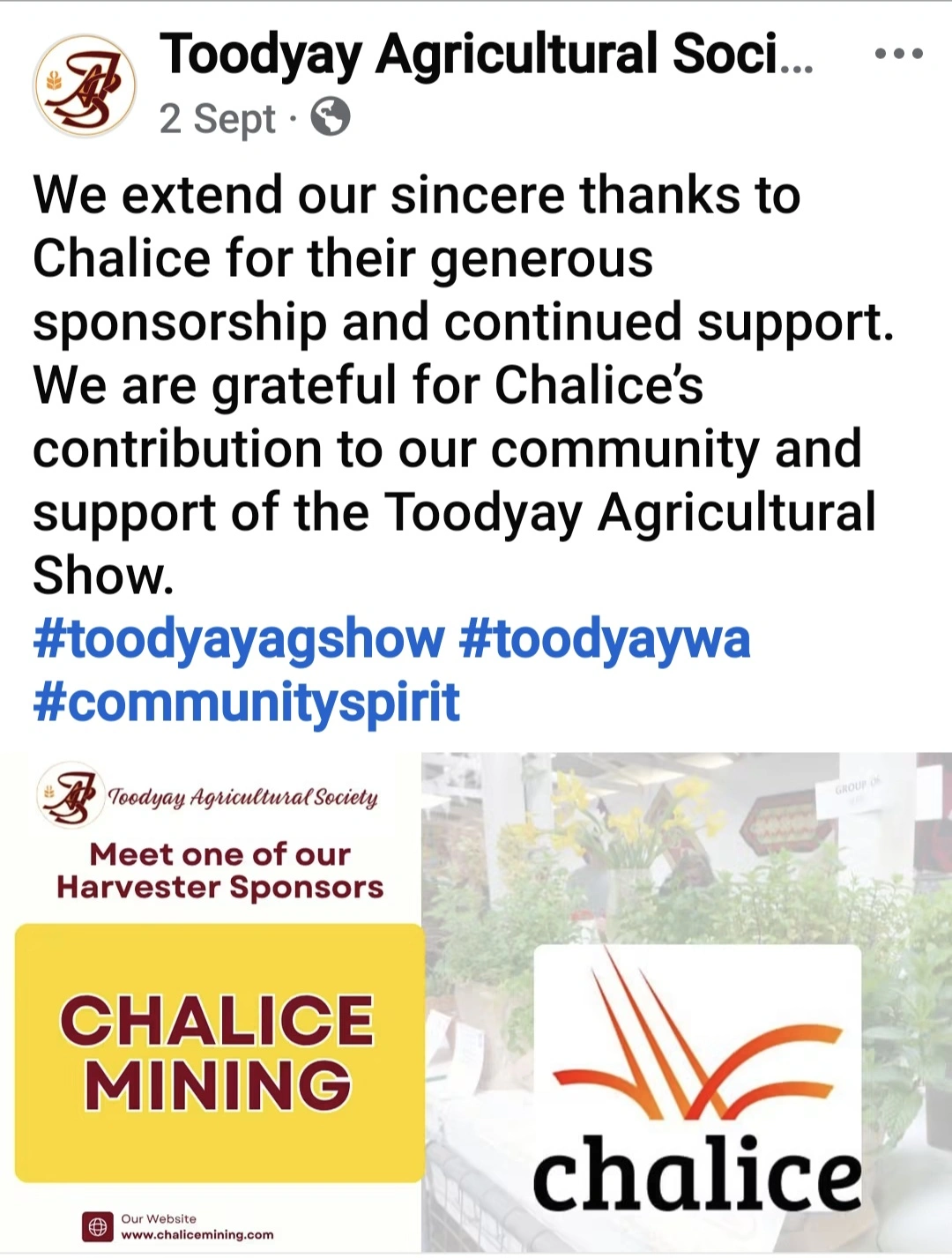
In September 2026, the Toodyay Agricultural Society publicly thanked Chalice for its “generous sponsorship and continued support” and said it was “grateful for Chalice’s contribution to our community”, alongside prominent Chalice branding as a Harvester Sponsor.
Accepting sponsorship does not mean an organisation, its committee or its members support Gonneville.
But sponsorship does something a private donation does not: it publicly associates the company with valued local organisations and events, generating visibility, recognition and goodwill in the very communities in which Gonneville is seeking acceptance.
That distinction matters when community support later becomes part of the case being made for the project’s social licence.
SOCIAL LICENCE HAS BUSINESS VALUE
For Chalice, social licence is not simply a public relations phrase. Its own corporate documents show that community trust and acceptance have strategic value.
Chalice has described community engagement as critical to earning trust and has identified “social licence to operate” as an interest of local communities. Its corporate strategy has included the objective to “build our sustainability brand, reputation and social licence”, while impaired social licence and loss of stakeholder support have been identified as business risks capable of disrupting activities or delaying approvals.
Community investment sits within that broader engagement framework.
That becomes particularly important when we look at how community sentiment is later presented to investors.
By May 2026, Chalice was telling investors that Gonneville’s approvals were “materially de-risked”. Among the reasons listed was:
“Strong community support, 500 local jobs and no FIFO.”
In other words, community support was no longer simply something being measured.
It had become part of Gonneville’s investment story and part of the argument that risk surrounding the project had been reduced.
So what did the community surveys actually find?
WHAT DID LOCAL VOICES ACTUALLY FIND?
Chalice has commissioned Local Voices surveys since 2023 to measure community attitudes towards the company and Gonneville.
The results are more nuanced than the later phrase “strong community support” suggests.
In 2023, 283 people participated. Trust in Chalice averaged 2.8 out of 5 and acceptance 3 out of 5 results described around the midpoint rather than overwhelming endorsement.
In 2024, 203 people participated. Trust remained at 2.8 and acceptance at 3. The headline figure was that 75% reported moderate-to-high support, but there was an important qualification: that support related to a potential mine on Chalice-owned farmland and was conditional on key concerns being addressed.
Then came the 2025 survey.
Participation fell again, to 180 respondents. Trust declined from 2.8 to 2.61. Acceptance fell from 3 to 2.79. And reported moderate-to-high support fell from 75% to 68%.
Voconiq’s own community summary was explicit:
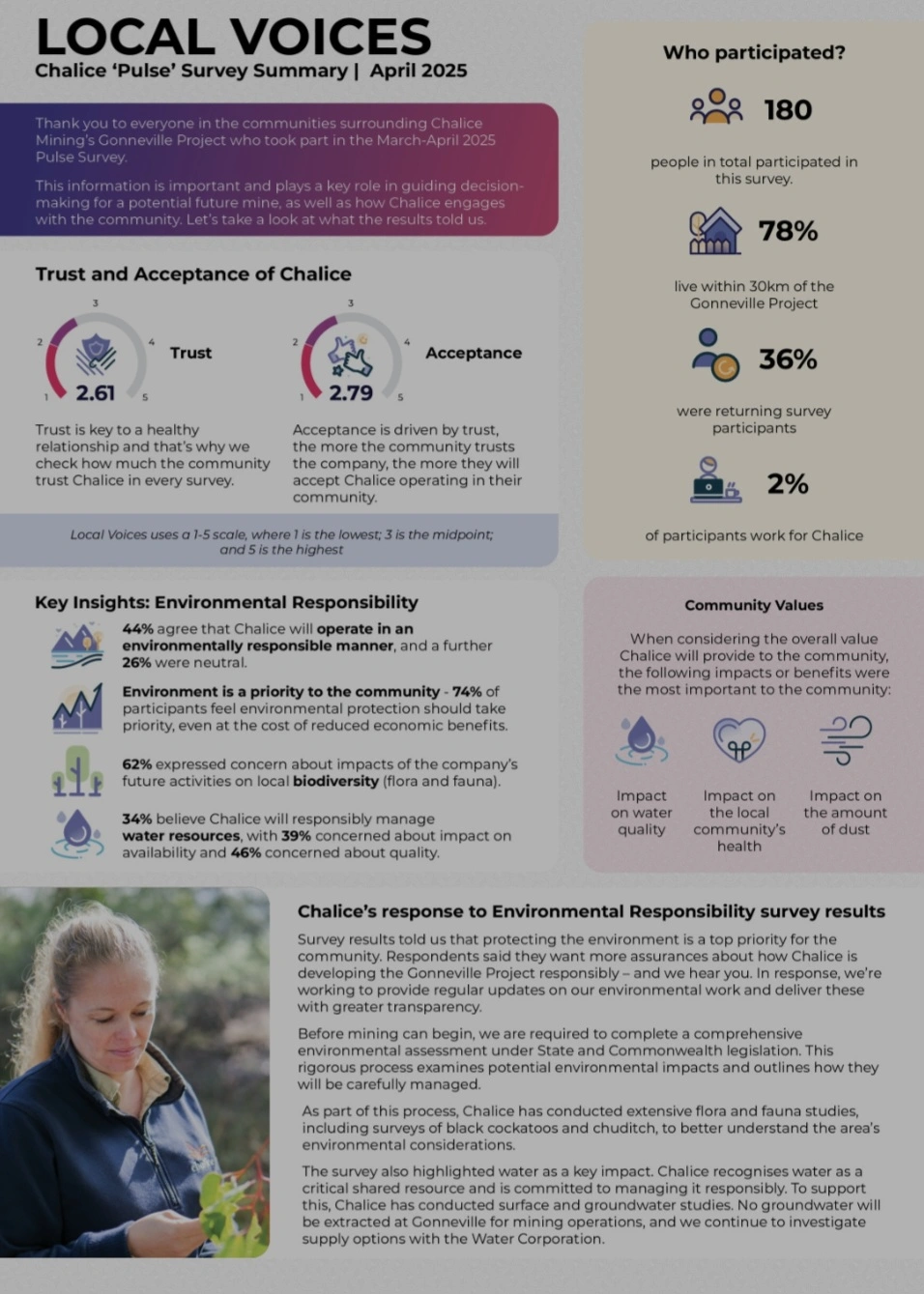
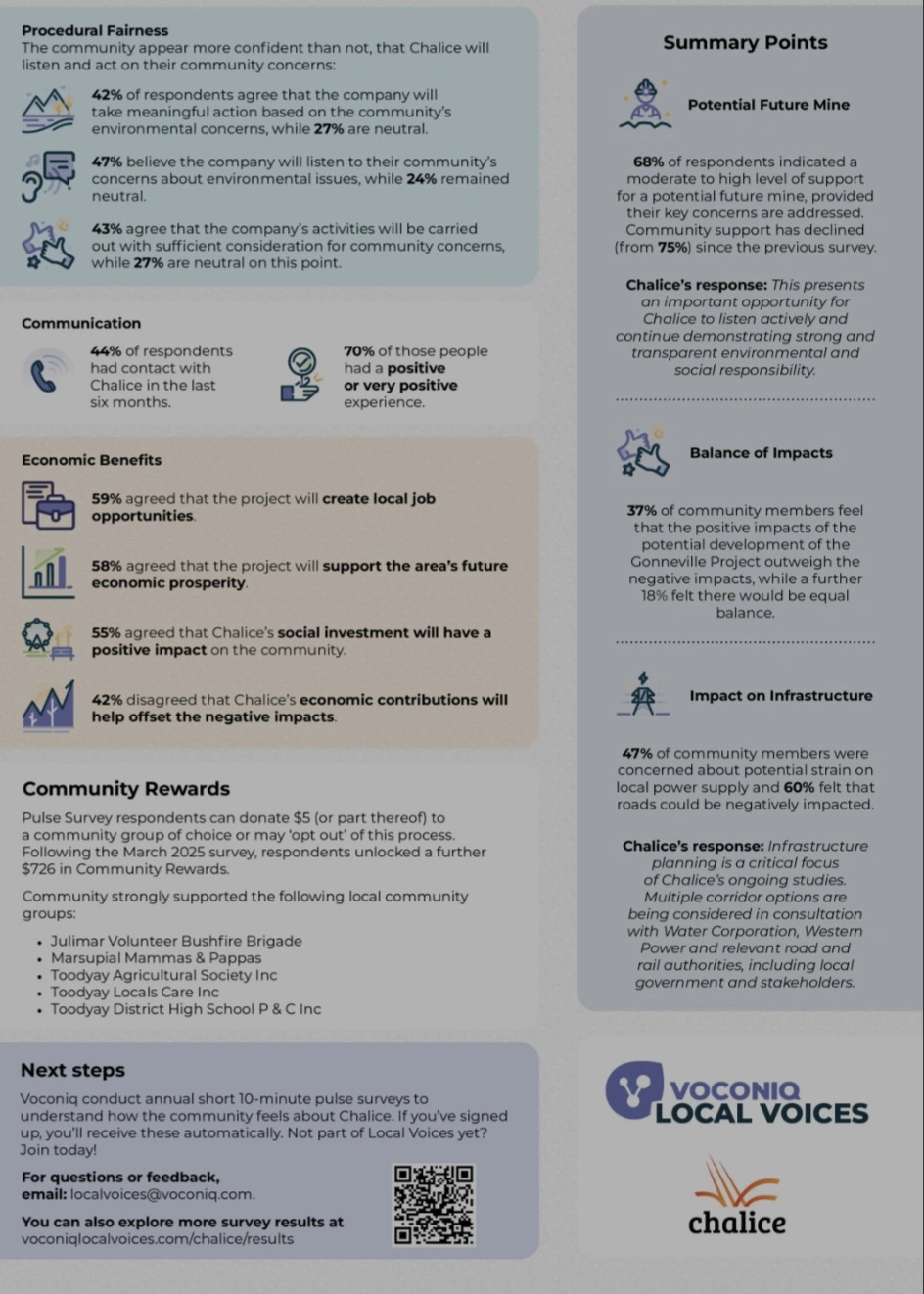
“Community support has declined.”
The same survey also revealed something important about the relationship between benefits and acceptance.
While 59% agreed Gonneville would create local jobs, 58% believed it would contribute to future economic prosperity and 55% believed Chalice’s social investment would have a positive community impact, 42% disagreed that the company’s economic contribution would offset the negative impacts of its activities.
And 74% said protecting the environment should take priority even if that meant reduced economic benefits.
Those results do not show a community incapable of recognising potential benefits.
They show a community weighing those benefits against potential consequences.
And that makes what happened to the survey findings as they moved into Chalice’s corporate reporting particularly important.
FROM CONDITIONAL SUPPORT TO “STRONG COMMUNITY SUPPORT”
This is where the wording matters.
The Local Voices surveys did not simply ask whether people supported “Gonneville” without qualification. The published results repeatedly referred to support for a potential mine on Chalice-owned farmland, and the 2024 and 2025 reporting attached important conditions concerning environmental management and community impacts.
But as those results travelled into corporate communications, much of that context became less visible.
In 2025, Chalice reported that 68% of respondents had a moderate-to-high level of support for a potential mine development on Chalice-owned farmland.
Elsewhere in its corporate reporting, that became:
“68% of respondents support the development of the Gonneville Project.”
By March 2026, Chalice was reporting that its three Local Voices surveys had “all indicated high levels of support for the Project.”
And by May 2026, the message presented to investors was shorter still:
“Strong community support.”
That statement appeared among the reasons Chalice said Gonneville’s approvals were “materially de-risked.”
Yet the most recent Local Voices survey available at that point showed trust had fallen, acceptance had fallen and support had fallen.
Voconiq said:
“Community support has declined.”
Chalice told investors:
“Strong community support.”
Both statements emerged from the same underlying community-engagement program.
The question is not whether 68% is a significant level of reported support. It is what, precisely, those respondents were supporting and whether the qualifications attached to that support remained sufficiently visible when the result was later used to describe community acceptance of the broader Gonneville Project.
THE BENEFITS ARE BROAD. THE IMPACTS ARE SPECIFIC.
There is another problem with treating broad community sentiment as evidence of social licence for the whole Gonneville development.
The mine does not exist in isolation.
Gonneville requires major infrastructure beyond Chalice-owned farmland, including power and water infrastructure extending through the surrounding district. That brings another group into the equation: the farmers and landholders whose properties, homes and immediate environments may be directly affected.
Their relationship with Gonneville is fundamentally different from that of someone who may benefit from a sponsored community event, local employment or increased economic activity.
This distinction matters because earlier Local Voices support figures specifically referred to a potential mine on Chalice-owned farmland.
That is not necessarily the same proposition as asking whether people support the complete development footprint, including major off-site infrastructure affecting land that Chalice does not own.
The benefits of Gonneville are promoted across the community.
But some of its consequences may be concentrated on a comparatively small number of people.
A broad measure of community support can therefore tell us something about general sentiment. It cannot, by itself, tell us whether those being asked to carry the greatest impacts have granted their social licence.
And those voices should not disappear inside a percentage.
SO WHAT DOES “SOCIAL LICENCE” ACTUALLY PROVE?
None of this establishes that community support has been bought, nor does receiving Chalice funding mean an organisation or its members support Gonneville.
But it does expose an important distinction.
A company supporting a community is not the same thing as a community supporting its project.
Community investment, sponsorship, local jobs and economic benefits all form part of the environment in which opinions about Gonneville are being formed. Independent Australian research has also found that perceptions of economic and community benefits can influence factors associated with social acceptance of mining.
That makes transparency around claims of community support particularly important.
If “strong community support” is significant enough to be presented to investors as one of the reasons Gonneville’s approvals are “materially de-risked”, then the evidence behind that claim deserves equally serious scrutiny.
Social licence should ultimately be judged by more than sponsorships, benefits or a headline percentage.
It should be judged by whether the people expected to live with the consequences believe those consequences are acceptable.