
SMOKE AND MIRRORS
Two Companies. One Corridor. Who Carries the Risk?
While Chalice Mining has been promoting community engagement, environmental responsibility and a financially attractive mining project, its own corporate records reveal another aspect of Gonneville's development that deserves public scrutiny.
On 14 April 2026, two new companies were registered in Western Australia:
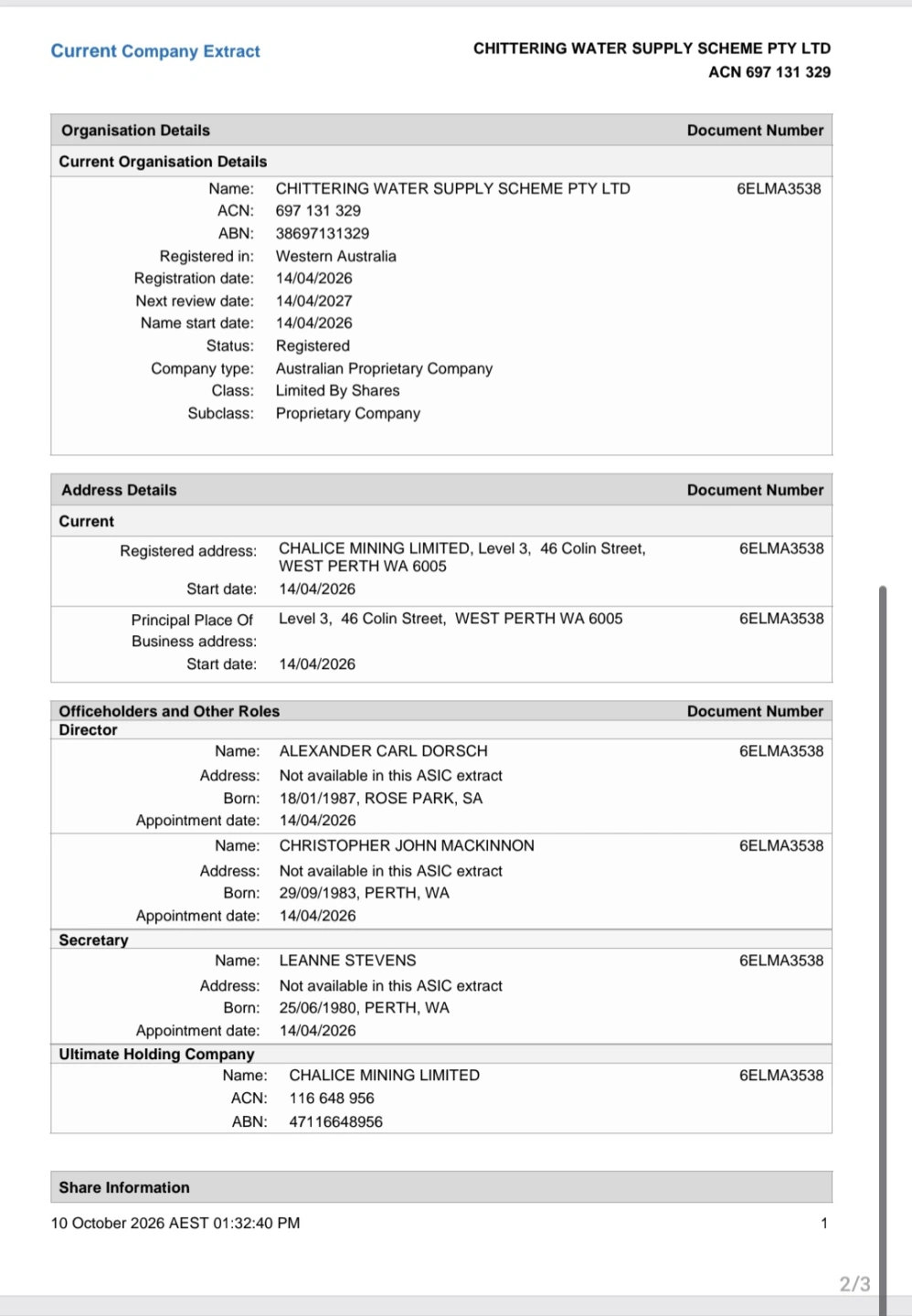
Chittering Water Supply Scheme Pty Ltd — ACN 697 131 329
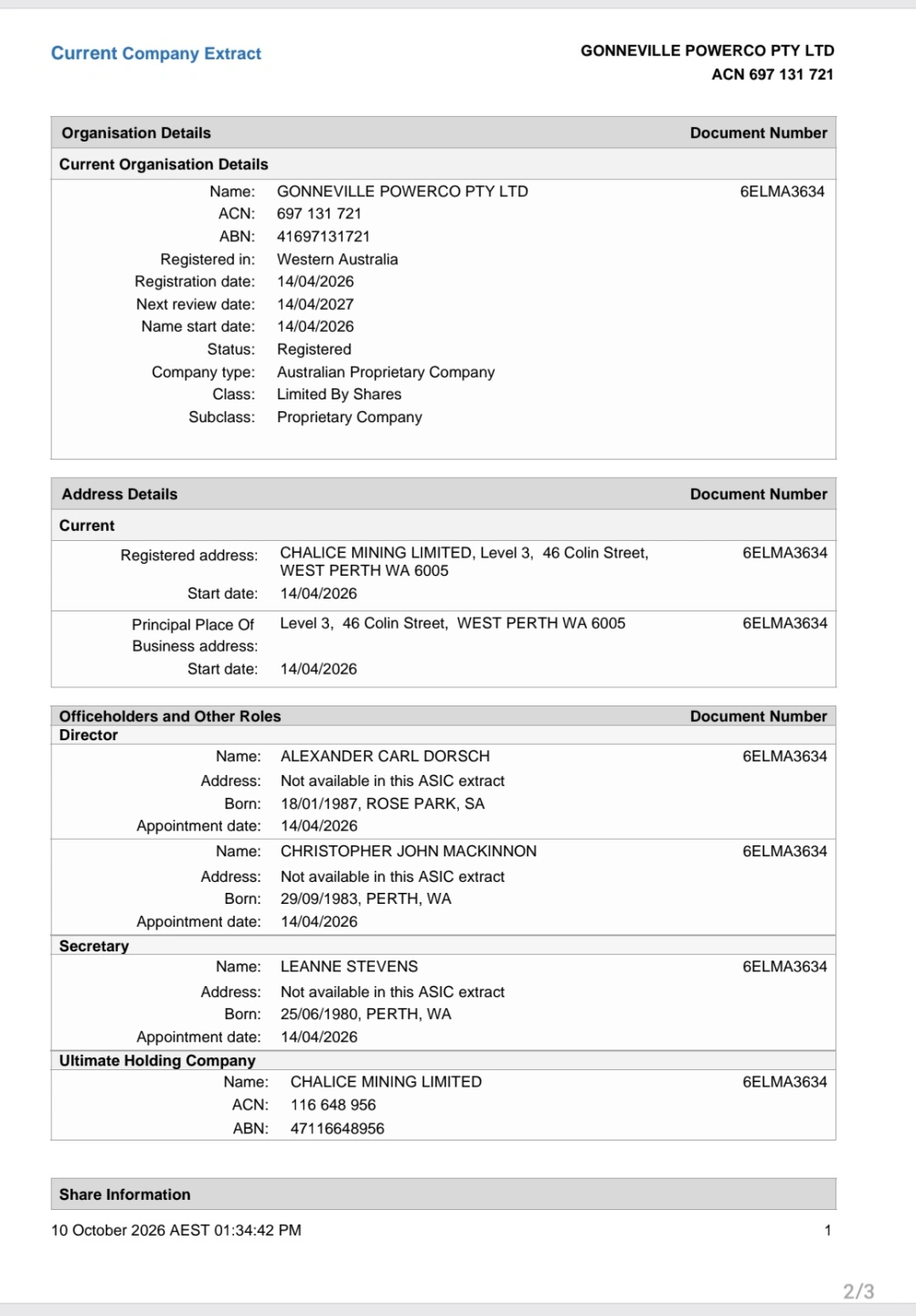
Gonneville Powerco Pty Ltd — ACN 697 131 721
Both were established on exactly the same day.
Both have the same directors, the same company secretary, the same direct shareholder and just $1 in issued share capital each.
And both were established before many Chittering landholders were informed that Chalice's preferred infrastructure corridor could directly affect their properties, homes and livelihoods.
These are confirmed facts from official ASIC company extracts obtained on 10 October 2026.
The creation of separate infrastructure companies is not, in itself, evidence of wrongdoing. But it raises serious questions about ownership, financial accountability and the long-term responsibilities associated with infrastructure that could affect private land for decades.
Who will ultimately control this infrastructure, who will carry its financial liabilities, and why have affected communities been left to uncover these corporate arrangements themselves?
The implications deserve far more attention than they have received.
WHO IS BEHIND THESE COMPANIES?
The ASIC records reveal that both companies are directed by senior Chalice Mining executives.
Alexander Carl Dorsch — Managing Director and Chief Executive Officer of Chalice Mining.
Christopher John MacKinnon — Chief Financial Officer of Chalice Mining.
Leanne Stevens — a senior member of Chalice's finance team, is company secretary of both companies.
Both are directly owned by CGM (WA) Pty Ltd, an existing Chalice subsidiary that also holds key Gonneville exploration tenements.
Their ultimate holding company is Chalice Mining Limited, and both share Chalice's West Perth business address.
Each company was established with just one fully paid ordinary share worth $1.
While this is common practice when establishing subsidiaries, it tells the public nothing about their future funding, assets or capacity to meet potentially substantial financial obligations.
And herein lies an important distinction.
A company can be wholly owned by Chalice without Chalice Mining Limited automatically being legally responsible for every debt or liability that company incurs.
Separate companies can hold assets, enter contracts, obtain financing and assume legal obligations in their own names.
Could these subsidiaries eventually hold the pipeline and powerline infrastructure, miscellaneous licences or agreements affecting private land?
If so, will Chalice Mining Limited provide legally enforceable guarantees covering maintenance, environmental damage, compensation, decommissioning and restoration?
And what happens if one of these companies is sold, becomes insolvent or no longer has the financial resources to meet those obligations?
There is no evidence that either subsidiary has been established to avoid liabilities. But neither do the publicly available records establish what financial protections will be provided.
Residents should not have to wait until infrastructure rights have been granted to discover which company will be legally responsible for the consequences.
THE TIMING RAISES QUESTIONS
On 14 April 2026, Chalice established two separate companies specifically named for its proposed water and power infrastructure.
Just 16 days later, on 30 April, Chalice's quarterly report told investors that environmental survey results and initial landholder feedback would help refine and narrow the potential infrastructure corridor options.
Further landholder engagement was still to follow.
By May, Chalice was contacting residents along its preferred corridor, including people who had previously been unaware that their homes, properties and livelihoods could be directly affected.
Chalice had undertaken earlier investigations and some landholder engagement during 2025. But many of the residents now facing the consequences had not been meaningfully involved in those initial decisions.
The registration of these companies does not prove that the final corridor alignment had already been selected.
But it does establish that Chalice was putting dedicated corporate arrangements for its infrastructure in place before many affected residents had even been consulted.
And that raises an uncomfortable question.
How far had Chalice's infrastructure planning progressed before the people expected to live with its consequences were given a meaningful opportunity to influence it?
Residents are still waiting to see the comparative assessments explaining why the preferred corridor was chosen, what alternatives were considered, and why avoiding established rural-residential estates was not given greater priority.
If those alternatives were genuinely assessed, the public deserves to see the evidence.
If avoiding residential communities would have cost more, that should be made clear too.
Commercial convenience and financial savings should not be allowed to quietly outweigh the long-term consequences for families, properties and communities.
The time for meaningful consultation is before consequential decisions are made, not after a preferred route has already been presented to the people expected to accommodate it.
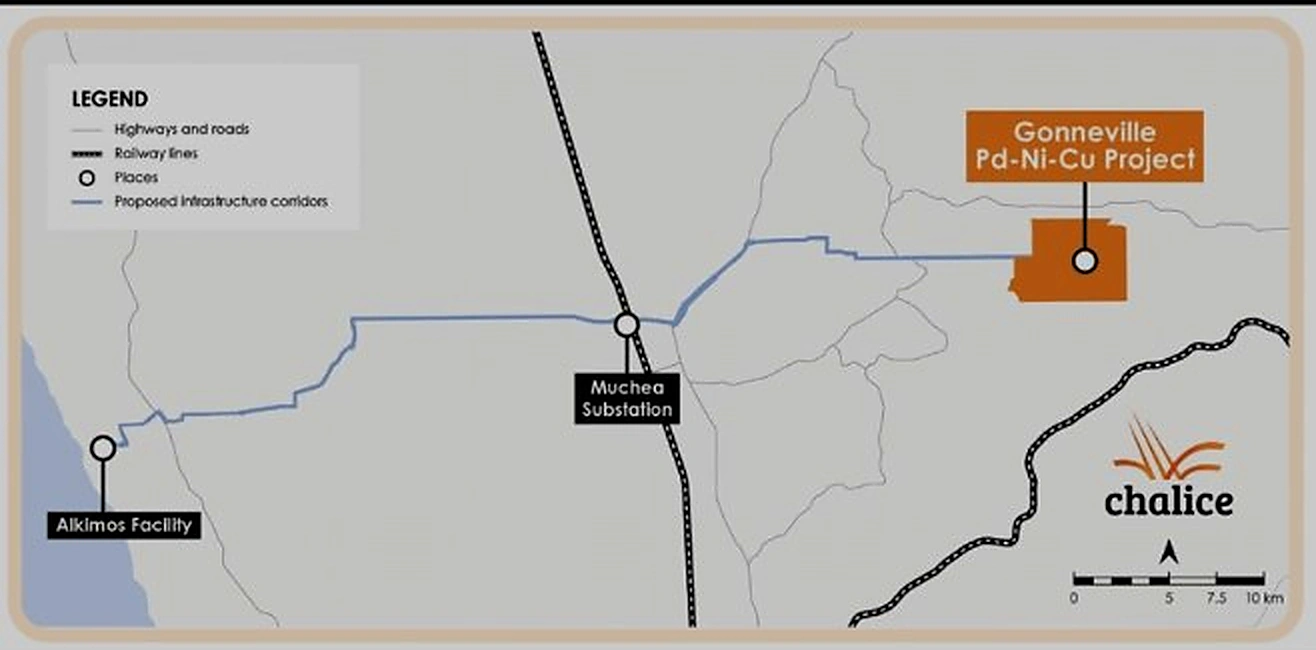
Chalice's published infrastructure corridor overview, showing the proposed connections between Alkimos, Muchea and Gonneville. Source: Chalice Mining.
THE MINE MAY BE ON CHALICE'S LAND. THE INFRASTRUCTURE ISN'T.
Chalice has repeatedly emphasised that its proposed Gonneville mine is located on company-owned farmland rather than within Julimar State Forest.
But that reassurance tells only part of the story.
The mine cannot operate without substantial supporting infrastructure extending far beyond the boundaries of Chalice's property.
Its proposed water pipeline would extend approximately 63 kilometres from Alkimos to Gonneville, alongside a high-voltage power connection through the Chittering district.
The preferred infrastructure corridor passes through established rural-residential areas, productive farmland and environmentally sensitive landscapes, potentially affecting private properties, waterways, mature woodland and wildlife habitat.
For the families living along that corridor, the fact that Chalice owns the proposed mine site offers little comfort.
Their properties are not Chalice's land. Yet they are being asked to accommodate infrastructure intended to serve Chalice's commercial development.
And now we know that two separate companies have been established within the Chalice corporate structure, specifically named for water and power infrastructure.
Will these companies eventually own or operate the pipeline and transmission line?
Will they apply for miscellaneous licences or hold land access rights across private properties?
Could those rights or infrastructure assets later be transferred to another operator?
And will affected landholders have any meaningful say in those arrangements?
The answers have not been established by the publicly available corporate records.
These are not minor administrative details. They concern the legal control of infrastructure that could remain across private land for decades.
Owning the mine site is one thing. Securing long-term infrastructure rights over other people's properties is quite another.
And the people whose land, homes and futures may be affected deserve to know exactly who they will be dealing with — and for how long.
FINANCIAL RISK DOES NOT END WHEN CONSTRUCTION FINISHES
Chalice describes Gonneville as a financially attractive mining project. But a positive Pre-Feasibility Study is not the same as a financed project, and projected profitability is no guarantee of financial security decades into the future.
Gonneville still requires major environmental approvals, substantial funding and a Final Investment Decision.
Its December 2025 Pre-Feasibility Study estimates approximately $820 million in Stage 1 pre-production capital alone, with further investment required for subsequent development.
And those are only part of the financial picture.
There will also be ongoing costs associated with operating, maintaining, repairing and eventually decommissioning the mine's supporting infrastructure.
But what happens when the financial assumptions change?
Chalice's Pre-Feasibility Study models a 23-year mining operation. Yet its 2026 Annual Report also identifies a scenario in which a similar mining plan could extend over approximately 55 years if economic conditions do not justify the proposed Stage 2 expansion.
That is potentially another 32 years of operations, with implications for infrastructure maintenance, land access, environmental monitoring and eventual restoration.
What financial arrangements would support those obligations over such an extended period?
And what happens if the opposite occurs, if commodity prices fall, financing becomes unavailable, or the mine closes earlier than anticipated?
Western Australia's Mining Rehabilitation Fund provides a financial safety net for abandoned mine rehabilitation, but contributions are not equivalent to fully securing every future rehabilitation expense. Nor should mine rehabilitation arrangements automatically be assumed to cover every obligation associated with off-site infrastructure crossing private land.
This is where the two newly incorporated companies become particularly relevant.
Both Chittering Water Supply Scheme Pty Ltd and Gonneville Powerco Pty Ltd were established with just $1 in issued share capital.
That does not mean they have only $1 available or that their future liabilities are limited to $1. But their ASIC extracts do not establish what financial backing, insurance or guarantees will support them.
If these companies eventually own or operate infrastructure across private properties, will Chalice Mining Limited remain financially accountable for their obligations?
Who will fund maintenance, environmental remediation, decommissioning and land restoration if the project changes ownership, closes early or never proceeds?
And could affected landholders be left pursuing a separate corporate entity rather than having a direct, enforceable guarantee from the parent company?
These questions need answers before long-term infrastructure rights are granted, not after financial difficulties arise.
The benefits of Gonneville may be projected in billions of dollars. But the costs of its infrastructure, environmental obligations and eventual closure must also be accounted for.
The profits may be uncertain. The infrastructure impacts could last for decades.
Who is guaranteeing that the money will be there when it is needed?
COMMUNITY SUPPORT OR CORPORATE MESSAGING?
Chalice has repeatedly promoted strong government and community support for Gonneville in presentations to investors.
But whose support is being counted, and how accurately does that message reflect the concerns of the people directly affected?
There is a considerable difference between general support for a mining development and informed acceptance of a major infrastructure corridor through established rural-residential communities.
Many affected residents were unaware of the proposed corridor when earlier community surveys and investigations were undertaken.
Others were informed about the preferred alignment only after substantial planning had already occurred.
Yet Chalice continues to promote its community engagement as a positive feature of the project's development.
Consultation is not the same as consent. And engagement is not proof of community support.
Chalice has also presented its decision to underground the proposed 132 kV powerline near Maryville Heights as a response to community feedback.
But underground transmission infrastructure requires significant engineering investigation and planning.
Was underground installation already being considered before residents objected? When were the different options assessed, and how much influence did community feedback actually have?
Those questions remain important because the company has not publicly established a clear timeline demonstrating how that decision was reached.
The same lack of clarity surrounds the preferred infrastructure corridor itself.
Residents have repeatedly sought an explanation of which alternative routes were investigated, how they were compared, and why options avoiding established rural-residential estates were not preferred.
The public has still not been shown the full comparison.
Now official ASIC records reveal that two separate infrastructure companies were established while corridor planning and community engagement were progressing.
There may be legitimate commercial reasons for those arrangements.
But how can affected communities properly assess what is proposed when fundamental information about route selection, corporate responsibility and long-term financial protections remains unresolved?
Transparency cannot mean releasing favourable information to investors while residents are left searching corporate registers for answers about infrastructure that may affect their properties for decades.
If Chalice wants its claims of meaningful engagement and strong community support to carry weight, those claims should be supported by evidence that affected communities have been properly informed, their concerns fairly represented, and their input genuinely considered.
Community confidence is not something a company can simply declare. It has to be earned through openness, accountability and demonstrable action.
WHO BENEFITS, AND WHO REMAINS RESPONSIBLE?
There is another important dimension to Chalice's infrastructure plans that deserves closer scrutiny.
Chalice has disclosed discussions with government concerning potential multi-user infrastructure, funding support and financing opportunities associated with Gonneville's development.
That raises questions extending well beyond the immediate needs of a single mine.
Is the proposed infrastructure being designed exclusively for Gonneville, or could it eventually support other developments?
And where do the two newly established infrastructure companies fit into those plans?
There is currently no verified evidence that either company has received public funding, entered into third-party supply arrangements or acquired ownership of the proposed infrastructure.
But that uncertainty is precisely why greater transparency is needed.
If government funding, publicly owned utilities or future commercial users become involved, affected landholders deserve to understand the financial and legal arrangements.
Who would own the infrastructure?
Who would collect any future revenue from its use?
Could ownership or operating responsibilities be transferred to another company?
Would landholders face continued restrictions or access requirements long after Gonneville's mining operations had ceased?
And if infrastructure originally justified by Gonneville becomes part of a broader network, who decides whether it stays, expands or serves another development?
These questions are particularly relevant to the proposed high-voltage power connection, given Chalice's identification of the Clean Energy Link through Chittering as a potential means of enabling its Stage 2 development.
The possibility of future infrastructure use must not be confused with an approved expansion or an established plan to supply other customers. But neither should it be dismissed when long-term rights over private land are being considered.
There is also the question of public financial exposure.
If government-supported finance or infrastructure investment becomes part of the project, what protections would ensure taxpayers and electricity or water customers are not left bearing unrecovered costs if Gonneville fails to proceed or operates differently from its financial projections?
Private commercial benefits should not come with unexplained long-term risks for landholders or the public.
The establishment of separate water and power companies makes it even more important to identify where ownership, revenue, obligations and liabilities will ultimately sit.
These arrangements may be entirely legitimate. But legitimacy does not remove the need for accountability.
The people whose properties may be affected deserve to know not only who intends to use their land, but who stands to benefit, who will pay, and who will still be responsible decades from now.
WHERE IS THE TRANSPARENCY?
For a company that repeatedly promotes its commitment to transparency, meaningful consultation and strong community support, there are still far too many unanswered questions surrounding Gonneville.
Residents have asked why the preferred infrastructure corridor was chosen, which alternatives were considered, why established rural-residential communities could not be avoided, and what the long-term consequences will be for their properties.
They are still waiting for the full comparison.
Now, through independently obtained ASIC records, we know that two separate infrastructure companies were established on 14 April 2026, under the directorship of Chalice's own senior executives.
Those registrations were not hidden. They were publicly accessible corporate records.
But publicly accessible information is not the same as proactively informing the people whose lives and properties may be affected.
Chalice has communicated its financial projections, development milestones and claims of community support to investors.
Yet fundamental questions remain about which companies may ultimately control infrastructure across private land, whether the parent company will guarantee their obligations, and who will be financially responsible if circumstances change.
The creation of these companies is not evidence of wrongdoing. But their existence raises legitimate questions that deserve clear, documented answers.
And those answers should not have to be extracted piece by piece by ordinary residents conducting their own investigations.
This is not simply about two companies registered for $1 each.
It is about the possibility of decades of infrastructure access, land-use restrictions, environmental responsibilities and financial obligations imposed on communities that have no commercial stake in Gonneville's success.
It is about decisions being progressed while the people who may carry the consequences are still trying to establish what has been decided, by whom, and why.
And it is about accountability.
If Chalice expects the Chittering Valley to accommodate infrastructure serving its commercial development, the community is entitled to know exactly who will own it, who will control it, and who will pay when something goes wrong.
Not after the licences are granted.
Not after the agreements are signed.
And certainly not decades later, when the mine has ceased operating.
The time for genuine transparency was before affected communities were presented with a preferred corridor.
That opportunity has already been compromised for many residents.
The very least they deserve now is full disclosure before further irreversible decisions are made.
Show us the corridor comparisons.
Show us the intended ownership arrangements.
Show us the financial guarantees.
And show us who carries the risk.
Because long after the investor presentations have ended and the mining equipment has gone, the Chittering Valley and the families who call it home will still be here.
SOURCES & OFFICIAL RECORDS
1. Australian Securities & Investments Commission (ASIC)
Official Current Company Extracts obtained 10 October 2026.
Chittering Water Supply Scheme Pty Ltd — ACN 697 131 329.
Gonneville Powerco Pty Ltd — ACN 697 131 721.
Confirming registration dates, directors, company secretary, shareholding arrangements and issued share capital.
https://asicconnect.asic.gov.au/public/faces/landingPage
2. Chalice Mining — 2026 Annual Report
Pages 14 and 115: Gonneville development scenarios, potential 55-year operating life and newly incorporated subsidiaries.
https://company-announcements.afr.com/asx/chn/f85b5ae7-bbdf-11f1-9f32-f657497195d4.pdf
3. Chalice Mining — March 2026 Quarterly Activities Report
Released 30 April 2026. Page 6: infrastructure corridor investigations, proposed miscellaneous licences, government engagement and potential multi-user infrastructure.
https://financialfilings.com/filings/chalice-mining-limited/interim-quarterly-report/2026/42799220/
4. Chalice Mining — Gonneville Pre-Feasibility Study
Released 8 December 2025. Contains the 23-year mine plan, projected development expenditure and financial assumptions.
https://investorpa.com/announcement-pdf/20251208/231936.pdf
5. WA Environmental Protection Authority — Gonneville Project
Official environmental assessment record identifying Chalice Mining Limited as the proponent, including the proposed mine and associated water and power infrastructure corridors.
https://www.epa.wa.gov.au/proposals/gonneville-nickel-copper-platinum-group-element-pge-project
6. ASIC — Company and Organisation Registers
Official guidance on accessing company registration and corporate information.
https://www.asic.gov.au/online-services/search-asic-registers/company-and-organisation-registers
Research current to 10 October 2026. The ASIC extracts establish the companies' registered details. Their intended infrastructure ownership, contractual responsibilities, financial guarantees and future operating arrangements have not been independently confirmed.