
BEYOND ONE MINE
COULD GONNEVILLE CHANGE THE FUTURE OF THE ENTIRE NORTHERN VALLEYS?
The proposed Gonneville mine raises a question that extends far beyond whether Chalice Mining should be permitted to extract minerals from its land near Julimar. It concerns the potential transformation of an entire semi-rural region on Perth's northern fringe, where established communities, productive farmland, native bushland, conservation values and a growing tourism economy could face decades of industrial development pressures.
For residents throughout Chittering, Bindoon, Toodyay, Wannamal, Julimar and the wider Northern Valleys, the consequences of Gonneville cannot be understood by examining the proposed mine in isolation. Its associated infrastructure would extend far beyond the mine site, introducing new electricity connections, a major water pipeline, construction activities and transport requirements into landscapes already occupied by people, farms and environmentally significant vegetation.
The concern becomes considerably more serious when the wider mineral exploration interests across the district are examined. Other companies already hold substantial exploration tenements, identified mineral resources and, in some cases, land-access agreements facilitating further investigations. Decisions concerning Gonneville could therefore influence the circumstances in which future mining developments are proposed and assessed.
The case advanced for Gonneville relies upon four familiar arguments: mineral deposits occur where geology places them, government mineral policies favour their development, access to existing infrastructure supports commercial viability, and employment and economic activity provide wider public benefits. None of these arguments, however, establishes whether the combined environmental, agricultural, economic and community consequences of major mining development across the Northern Valleys would be acceptable.
The central issue is whether the approval of one mine could establish a pathway towards further industrialisation of the region, without the full cumulative consequences ever being adequately examined.
This investigation considers the assumptions behind those arguments, the documented mineral interests beyond Gonneville and the responsibilities of the Western Australian and Commonwealth Governments in determining the region's future.
GEOLOGY DOES NOT DETERMINE THE FUTURE OF A REGION
One of the most persistent arguments used to justify mining in environmentally sensitive locations is that mineral deposits can only be extracted where nature placed them. Although geological conditions determine where a deposit occurs, they do not determine whether mining should proceed or what consequences governments should permit.
The decision to develop a mineral deposit involves commercial choices about excavation, processing, waste storage, transport, infrastructure and operating life. These are components of an industrial development proposal, not inevitable consequences of geology. Their acceptability must be examined against the characteristics and existing uses of the surrounding landscape.
Chalice's proposed Gonneville operation would involve a substantial open pit, mineral-processing facilities, waste rock landforms, tailings storage and associated infrastructure. The December 2025 Pre-Feasibility Study describes a final open pit approximately 1.7 kilometres long, one kilometre wide and 450 metres deep. The proposed development would also require supporting infrastructure and transport arrangements extending beyond the land occupied by the mine itself.
The broader consequences cannot be dismissed simply because parts of the proposed mine site have previously been cleared for agriculture. The environmental significance of surrounding bushland, neighbouring properties, waterways and the proposed infrastructure corridors must be assessed in their own right.
The argument that minerals must be mined where they occur also fails to address what could happen after the first major operation is approved. Establishing mining infrastructure and industrial land uses in an existing rural district could influence the practical and commercial circumstances of subsequent developments. The original deposit might therefore become the starting point for changes extending beyond its own boundaries.
Geology may determine where minerals exist, but it does not establish that an entire region should be expected to accommodate their extraction. That remains a decision for government, requiring consideration of what could be permanently changed or lost.
THE CRITICAL MINERALS ARGUMENT CANNOT OVERRIDE ENVIRONMENTAL RESPONSIBILITIES
Government policies encouraging the development of particular mineral resources have become an important part of the justification for Gonneville. But supporting a mineral industry through economic policy is not the same as establishing that every proposed development within that industry is environmentally acceptable.
The consequences of mining occur where the operation and its infrastructure are established. They include land clearing, waste management, potential effects on waterways, disturbance to wildlife habitat, industrial transport and long-term changes to surrounding land uses. Those consequences require assessment regardless of how the extracted materials might ultimately be used.
The more significant concern is what happens when government development policies are repeatedly applied across a region containing multiple mineral interests. One project may be advanced on the basis of economic priorities, followed by another proposal involving a different deposit or company. Individual developments may then be examined through separate regulatory processes, while their combined effects on vegetation, waterways, agricultural land and communities continue to accumulate.
A succession of individual approval decisions could ultimately produce a regional outcome that was never adequately examined as a whole.
This is particularly relevant to the Northern Valleys because further exploration activity is already documented across the surrounding districts. The question is not simply whether Gonneville meets environmental requirements when assessed as one proposal. It is whether government decision-making is sufficiently comprehensive to recognise the longer-term implications of establishing major mining operations within a region already experiencing additional mineral exploration pressures.
The national interest also includes protecting threatened species, nationally significant ecological communities, agricultural productivity, biodiversity and the long-term wellbeing of regional communities. These responsibilities do not become secondary merely because a mining proposal falls within a government-supported industry.
Government mineral policy cannot substitute for evidence that the full environmental and regional consequences of a development are acceptable.
THE INFRASTRUCTURE ARGUMENT OVERLOOKS THE LANDSCAPE BETWEEN PERTH AND GONNEVILLE
Gonneville's proximity to Perth is frequently presented as a reason why developing the mine is commercially practical. That argument overlooks the substantial new infrastructure required to connect the proposed operation to existing services.
Chalice's September 2026 Annual Report identifies an approximately 63-kilometre water pipeline connecting Gonneville to the Alkimos Water Resource Recovery Facility and a new approximately 27-kilometre high-voltage electricity transmission connection from the Muchea area.
These are major infrastructure requirements extending across a landscape occupied by established properties, agricultural operations, waterways and native vegetation. The associated consequences cannot be confined to the mine site simply because the infrastructure exists to service that mine.
The preferred corridor has been refined during 2026, and the current alignment must be assessed using current ecological and land-use information. However, selecting a preferred route does not establish that its consequences are environmentally or socially acceptable. It makes the need for detailed scrutiny more immediate.
THE BANKSIA WOODLANDS AND THE ECOLOGICAL COST OF A 63-KILOMETRE CORRIDOR
The potential disturbance of Banksia woodlands is among the most serious environmental concerns associated with Gonneville's supporting infrastructure.
The Commonwealth lists the Banksia Woodlands of the Swan Coastal Plain ecological community as endangered. Chalice's March 2024 environmental referral identified this protected community as likely to occur within its broader infrastructure development envelope.
That finding raises substantial questions about the condition, location and ecological significance of vegetation potentially affected by the refined corridor. The exact clearing footprint must be established through current surveys, but the need for detailed assessment of sensitive vegetation and habitat fragmentation is already apparent from the earlier environmental documentation.
Banksia woodlands and surrounding native vegetation contribute to ecological systems supporting native fauna, including threatened black cockatoos. Carnaby's Black Cockatoos and Forest Red-tailed Black Cockatoos depend upon suitable feeding, breeding and movement habitat. Maintaining an individual nesting tree does not necessarily protect the wider habitat upon which breeding birds depend.
Infrastructure construction can disturb these relationships through vegetation clearing, excavation, changes to drainage, machinery access and fragmentation of existing vegetation connections. A pipeline may eventually be buried, but the ecological effects of its construction can persist long after the ground surface has been reinstated.
Established native vegetation cannot necessarily be recreated through planting or rehabilitation, particularly where mature trees, soil conditions and ecological relationships have developed over many decades.
The full construction footprint, surrounding habitat and cumulative vegetation loss must therefore be examined together. An assessment restricted to the width of the pipeline trench or the number of individual trees removed would not adequately describe the broader ecological consequences.
The environmental issue is not simply whether engineering works can be completed along a selected alignment. It is whether the resulting disturbance is justified in a landscape where remaining native vegetation already performs important ecological functions.
THE LAND IS ALSO HOME TO FARMING FAMILIES
The proposed infrastructure corridors also raise significant questions about existing agricultural operations and private property.
Working farms are interconnected businesses. Fencing, pasture management, livestock movements, machinery access, dams, drainage, water supplies and biosecurity arrangements all contribute to their productivity. Construction activities and enduring easements can affect these systems in ways that extend beyond the narrow area directly occupied by infrastructure.
Semi-rural residential properties face different but equally important concerns. Many were established around the natural landscape, native bushland and semi-rural amenity that attracted families to the district. Some adjoin vegetation subject to longstanding preservation conditions or other land-use protections.
Temporary compensation arrangements cannot necessarily restore lost environmental values, eliminate disruption to agricultural operations or compensate for every enduring change to a family's home and surroundings. The existence of statutory landholder protections also does not remove the uncertainty, expense and practical difficulties associated with negotiating major infrastructure across established properties, particularly where easements could restrict the use of substantial areas of privately owned land.
For some families, these restrictions could affect a significant proportion of their property, potentially undermining the very purpose for which the land was purchased and maintained.
Chalice's commercial need for infrastructure does not establish that the disturbance of neighbouring properties is an acceptable consequence. Nor does the convenience of a proposed alignment justify treating farmland and semi-rural homes as vacant space on a development map.
The cumulative concern becomes more significant when future infrastructure requirements are considered. If Gonneville establishes major utility corridors through the district, those corridors could influence later decisions concerning access, land use and further development. The consequences of establishing them may therefore extend beyond the requirements of the initial mining proposal.
THE ECONOMIC ARGUMENT LEAVES OUT THE REGION THAT ALREADY EXISTS
The economic case advanced for Gonneville concentrates on projected employment, expenditure and government revenue. These forecasts describe potential activity associated with a mining operation that has not yet entered production, but they do not establish the full economic consequences for the communities and businesses already operating throughout the Northern Valleys.
Chalice's September 2026 Annual Report forecasts 419 direct residential operational jobs.
Direct employment would also depend upon applicants possessing the qualifications, technical capabilities and experience required for particular positions. The number of projected jobs does not establish how many would ultimately be filled by people living near the proposed operation.
More fundamentally, the creation of employment does not, by itself, demonstrate that the consequences of establishing a major mining operation in an existing semi-rural region are acceptable.
Residents have made significant personal and financial decisions about where and how they wish to live. Many have established homes, farms and businesses in the Northern Valleys specifically because of the natural environment, agricultural opportunities, peace, space and distance from major industrial development.
Some families have invested their life savings and spent decades protecting native vegetation, improving their properties and building a semi-rural lifestyle that could be affected by Gonneville and its associated infrastructure.
Against that background, accusations that residents are selfish for raising objections deserve careful examination. People seeking employment closer to home have legitimate interests, but those interests do not automatically take precedence over the established homes, livelihoods and environmental values of their neighbours.
FIFO employment and long commutes can be demanding. However, the employment arrangements chosen by individual workers cannot determine whether an entire district should accommodate a major mining development. Training, qualifications and employment opportunities may change over time, while the consequences of major physical alterations to a semi-rural landscape can remain for generations.
The appropriate public-interest assessment must therefore examine both the potential employment benefits and what the surrounding region would be required to sacrifice and accommodate.
A preference for employment closer to home cannot, by itself, justify imposing lasting environmental, financial or lifestyle consequences on neighbouring families.
There is a further problem with the economic argument. The projected financial benefits of Gonneville could be distributed among governments, investors, suppliers, contractors and workers across Western Australia and beyond. The physical consequences, however, would be concentrated much closer to the mine, its infrastructure corridors and associated transport routes.
A meaningful economic assessment must therefore consider not only activity a mine could generate, but also existing productive industries, land uses and businesses that could face disruption or diminished opportunities.
Nowhere is that distinction more important than in the Northern Valleys' established agricultural and tourism economy.
THE NORTHERN VALLEYS TOURISM ECONOMY: AN EXISTING INDUSTRY AT RISK
The Northern Valleys occupy a distinctive position on the edge of metropolitan Perth. Their appeal is built upon the opportunity to experience a semi-rural landscape of rolling farmland, native bushland, wildflowers, orchards, wineries, scenic roads, wildlife and country hospitality without travelling far from the city.
The region's semi-rural character is not simply a pleasant backdrop. It is a central part of what attracts visitors and supports an established network of accommodation providers, hospitality businesses, local food producers, wineries, farm-based enterprises, markets and tourism events.
Destination Perth actively promotes the Northern Valleys as a country escape, with Chittering and Bindoon forming part of a wider visitor experience that includes scenic drives, wildflowers, local produce and countryside attractions. Toodyay contributes its own heritage, accommodation, hospitality and natural attractions to the wider visitor economy.
The region's proximity to Perth is fundamental to that appeal. Residents of the metropolitan area can readily visit for a day trip or short break, experiencing a landscape and lifestyle that differ from the urban environment they are leaving behind.
The potential cumulative effects of mining development must therefore be examined against an economy that already depends upon the character of the region.
Major infrastructure corridors, heavy vehicle movements, construction activities, vegetation clearing and the establishment of industrial operations could affect scenic routes, semi-rural amenity and the visitor experience. Their effects could extend beyond properties immediately adjoining a mine or transport corridor, particularly if the wider region becomes increasingly associated with industrial activity.
Tourism also depends upon reputation and visitor expectations. People choose destinations because of the experiences they anticipate. A gradual change in the visual character, tranquillity and accessibility of a semi-rural area could affect decisions about where visitors travel, stay and spend money.
The risk becomes greater when Gonneville is considered alongside existing mineral exploration interests. One operation might introduce certain changes to the landscape. Further developments, additional corridors or increased heavy haulage could progressively alter the character of the region that tourism businesses depend upon.
The Northern Valleys cannot indefinitely be promoted as a peaceful semi-rural escape while the cumulative consequences of major industrial development are treated as unrelated to the future of tourism.
This is not merely a question of visual amenity. It concerns existing businesses, employment, visitor expenditure and future investment in tourism. A decline in the region's attractiveness could affect accommodation providers, hospitality venues, small producers and other enterprises whose livelihoods depend on visitors continuing to choose the Northern Valleys.
The economic assessment of Gonneville should therefore examine the potential impacts on the region's existing tourism economy, including scenic routes, visitor behaviour, business confidence and future development opportunities.
If governments place substantial weight on projected mining employment and revenue, they must also establish how existing industries could be affected by the introduction and potential expansion of industrial land uses.
Otherwise, the economic case risks counting what might be created without adequately accounting for what could be diminished or lost.
ROADS, TRANSPORT AND REGIONAL SAFETY CANNOT BE ASSESSED IN ISOLATION
The effects of Gonneville would also extend through its transport requirements. Chalice's published mine plan assumes road haulage of mineral concentrates, creating the potential for significant heavy vehicle movements and associated road infrastructure changes.
Semi-rural roads throughout the Northern Valleys currently serve residents, farming businesses, school transport, tourists, local services and emergency vehicles. Many also function as scenic routes supporting the region's tourism identity.
The introduction of substantial mining-related traffic could affect road safety, noise, amenity, wildlife movements and maintenance requirements. Proposed road modifications may change the physical character of routes presently used for agricultural and community purposes.
The implications for emergency response and bushfire evacuation are particularly important in a district containing extensive bushland and semi-rural properties. Increased traffic and changes to road access must be considered alongside existing emergency-management needs.
These consequences cannot be fully understood by assessing transport requirements solely in terms of whether roads have sufficient engineering capacity to accommodate heavy vehicles. Their importance lies in how the roads function within the wider region and the competing needs of the people and industries already using them.
The cumulative question is again significant. If further resource developments were eventually proposed across the Northern Valleys, additional transport demands could place increasing pressure on the same road networks.
The combined effect of successive developments could be substantially different from the consequences identified for one project operating alone.
Roads, tourism, agriculture, wildlife and emergency services are all connected through the same regional transport network. An adequate assessment must recognise that relationship.
THE MINING INTERESTS ARE ALREADY HERE
The concern about future mining development is not based solely on hypothetical deposits or distant possibilities. Western Australian mineral tenement records and publicly available company disclosures demonstrate that substantial exploration interests already exist across the Northern Valleys.
Western Yilgarn's Julimar West Bauxite Project provides an important example. Exploration licence E70/5111 covers approximately 349 square kilometres near Bindoon, where the company has identified a significant inferred bauxite resource.
Its September 2026 Annual Report confirms that land-access agreements were secured in January over two resource areas known as Lode 100 and Lode 200. Together, these contain an inferred resource of approximately 104.8 million tonnes. The agreement relating to Lode 200 includes landholder consent concerning surface rights under Section 29 of the Mining Act 1978.
These arrangements facilitate further resource investigations and potential development studies. They demonstrate that Western Yilgarn's activities have progressed beyond the mere holding of exploration tenure.
Western Yilgarn also holds exploration interests at Julimar North and Julimar North West, and its 2026 reporting identifies additional exploration and resource investigation activities in the wider Central Bindoon and Toodyay districts.
Chalice retains exploration interests beyond the proposed Gonneville mine, while other companies hold or have applied for mineral tenements across surrounding areas.
The extent of this activity is illustrated by WA Government TENGRAPH mapping, which provides a geographical view of mineral interests extending across agricultural land, semi-rural communities, native bushland and areas adjoining important conservation values.
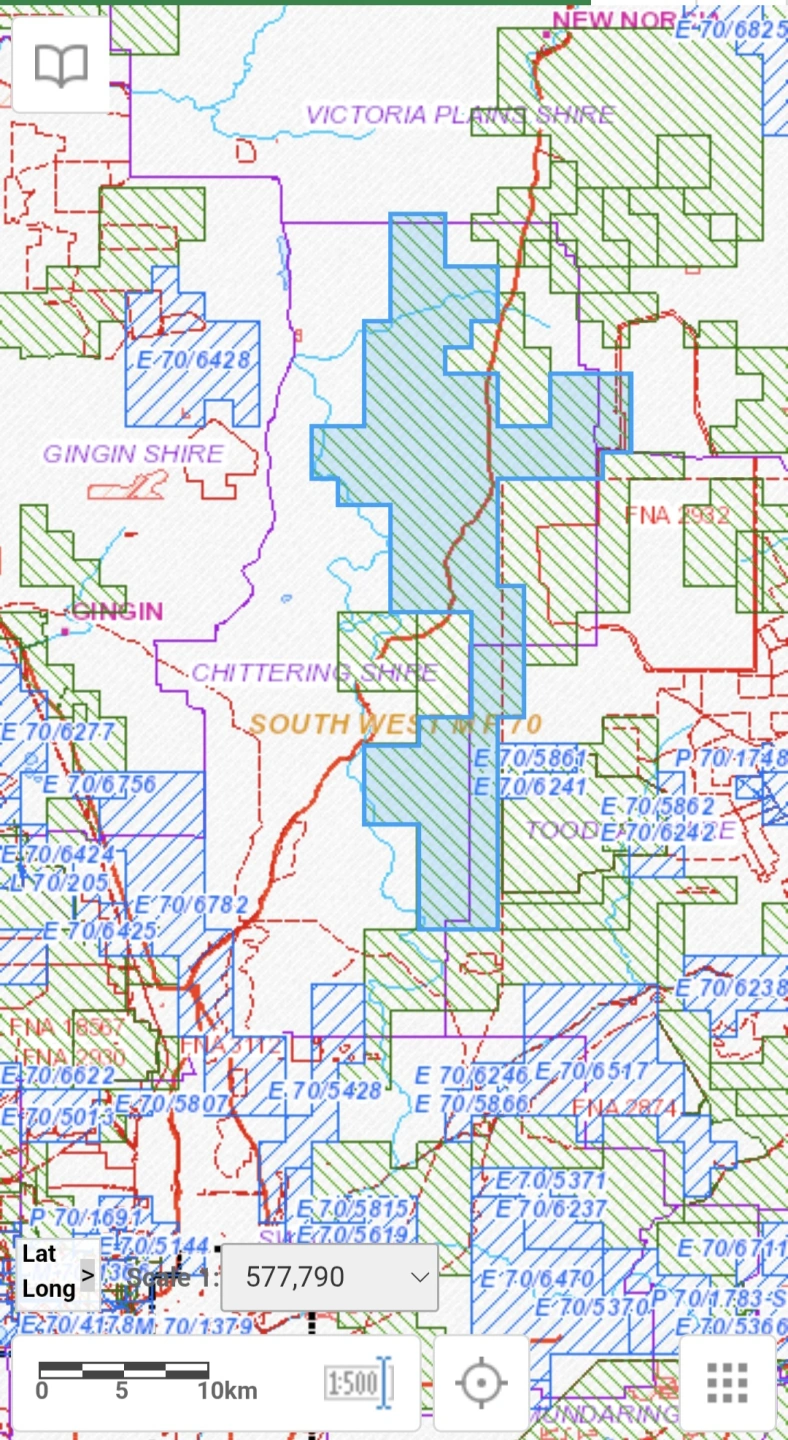
Map: WA Government TENGRAPH mineral tenure mapping across the wider Northern Valleys. Tenements and applications represent mineral interests, not approvals to commence mining. The map reflects tenure information at the time the image was captured.
The significance of this mapping lies not simply in the number of tenements, but in their geographical relationship to the region's existing environmental, agricultural and community values.
Historical Western Yilgarn documentation has identified exploration licence overlap with Julimar State Forest and areas associated with earlier conservation planning proposals. The legal conditions governing individual licences determine what exploration activities may occur, but these records reinforce the importance of examining mineral tenure alongside environmental protection and existing land use.
Julimar State Forest and surrounding remnant vegetation form part of a broader ecological landscape supporting native wildlife, waterways and habitat connections. These environmental systems do not end at mining tenement boundaries, just as the agricultural and community consequences of development do not necessarily stop at local government boundaries.
The documented extent of regional mineral exploration demonstrates why Gonneville cannot be regarded simply as an isolated mining proposal. Decisions made about one substantial development could influence the circumstances under which other mineral interests are pursued in the future.
WHAT COULD GONNEVILLE ENABLE?
The potential precedent created by approving Gonneville is among the most consequential issues facing the Northern Valleys.
Precedent in this context is not simply a legal question. It concerns the practical effects of establishing a major mining operation, industrial infrastructure and new land-use arrangements within a region that already contains further mineral development interests.
Once electricity connections, water pipelines, access routes and an operating mine are established, the physical and commercial circumstances surrounding later development proposals may change. Future companies may examine the existing infrastructure and industrial presence when assessing the feasibility of their own projects.
There is documented evidence that broader infrastructure possibilities have already formed part of Chalice's discussions with government. In its June 2026 quarterly reporting, Chalice described engagement with the Western Australian and Commonwealth Governments concerning potential multi-user infrastructure and other forms of government support.
That disclosure raises an important issue extending beyond the engineering requirements of Gonneville itself. The public should be able to understand what types of infrastructure have been discussed, whether public investment or support is contemplated, what future users might be envisaged and how any wider regional consequences would be assessed.
It does not establish that other mining companies have secured access to Gonneville infrastructure. It establishes that the question of potential multi-user infrastructure has been part of the company's government engagement.
That makes the longer-term purpose and possible use of major infrastructure a legitimate subject for public scrutiny.
The precedent concern also extends beyond physical infrastructure. Approving a major mine can change the land-use context in which subsequent developments are considered. Once industrial activity becomes established, future proponents may argue that additional operations are compatible with an area already accommodating substantial mining infrastructure.
Over time, separate proposals could contribute to a progressively different semi-rural landscape, even where each development has been considered through its own approval process.
The concern is particularly serious when viewed alongside existing exploration interests, agricultural land, conservation areas and the Northern Valleys tourism economy. What is initially considered as one mining development could become part of a broader shift in land use whose consequences extend far beyond the original mine.
The risk is that an entire region could be progressively transformed through a succession of individual development decisions without the combined long-term environmental, agricultural, social and economic consequences ever being adequately examined.
That is the central cumulative-impact issue raised by Gonneville.
THE DEVELOPMENT TIMEFRAME MAY EXTEND ACROSS GENERATIONS
The time horizon of Gonneville is also relevant to its cumulative consequences.
Chalice's December 2025 Pre-Feasibility Study models a 23-year open-pit operation. However, its September 2026 Annual Report discusses an alternative development scenario in which a similar mining plan could extend to approximately 55 years if the planned Stage 2 processing expansion did not proceed.
The same reporting discusses the possibility of future underground mining beyond the currently modelled open-pit development.
These possibilities are not approvals for future expansion. Their significance is that they demonstrate the potential for the development's commercial and physical presence to extend well beyond a single operating scenario.
Environmental consequences may also continue after production ends. Waste management, rehabilitation obligations, altered landforms, vegetation loss and habitat fragmentation may require monitoring or management for many years.
New infrastructure can likewise influence land-use decisions long after its original construction.
For cumulative assessment purposes, the consequences of a development must therefore be examined over an appropriate timescale, taking account of enduring environmental changes, potential future activities and the longer-term regional pressures that could arise.
A mining proposal considered principally through one commercial operating model may not provide a complete picture of the future land-use consequences of establishing major industrial infrastructure across an existing semi-rural district.
WHAT DOES A REGIONAL CUMULATIVE IMPACT ASSESSMENT ACTUALLY INCLUDE?
Western Australia's Environmental Protection Authority published updated cumulative impact assessment guidance in February 2026. The guideline recognises increasing development pressures on the state's environment and the importance of examining the combined effects of relevant past, present and reasonably foreseeable future activities.
Cumulative impact assessment is therefore not a concern outside the existing environmental framework. It is an explicitly recognised part of environmental impact assessment under the Environmental Protection Act 1986.
However, the existence of assessment requirements does not establish that the cumulative consequences of Gonneville have already been adequately examined.
The geographical boundaries, environmental values, development scenarios and assessment timeframes used in a cumulative study determine what that study can meaningfully reveal. An assessment restricted too narrowly may fail to capture effects extending across multiple infrastructure corridors, waterways, vegetation communities or regional land uses.
Gonneville's Environmental Scoping Document was approved in November 2024, before the EPA's updated February 2026 cumulative impact assessment guideline was published. The publicly available assessment record does not yet provide the completed Environmental Review Documents for public examination.
The central accountability issue is therefore how the EPA and Chalice will demonstrate that the assessment adequately captures the full environmental consequences of the current project and relevant regional pressures.
This includes examining the combined effects of the mine, its electricity and water infrastructure, associated transport requirements, existing habitat fragmentation and other activities considered reasonably foreseeable under the applicable assessment framework.
The treatment of additional mineral exploration interests is particularly important. Not every exploration licence represents a future mine, but the existence of identified resources, land-access agreements and active development investigations provides information that regulators should consider when determining which potential activities are sufficiently foreseeable for cumulative assessment.
That determination should be transparent. The public should be able to understand what has been included, what has been excluded and the evidence supporting those decisions.
A further issue extends beyond the EPA's immediate environmental responsibilities. Tourism in this semi-rural region, agricultural viability, public infrastructure, private property and emergency services are affected by development decisions made through several different regulatory and administrative processes. Their combined consequences may not be fully captured by an environmental assessment alone.
This makes coordination between government authorities essential. A development may be examined under separate approval processes, but the communities and landscapes affected experience the consequences together.
A cumulative assessment is only as comprehensive as the activities, environmental values, geographical boundaries and timeframes it includes.
For the Northern Valleys, the question is whether those boundaries will be sufficiently broad to reveal the consequences of major mining development across the entire affected landscape, rather than merely describing individual impacts within separate development envelopes.
SOCIAL LICENCE: WHO HAS AGREED TO THE FUTURE BEING PROPOSED?
There is another dimension to Gonneville's regional consequences that cannot be captured through environmental modelling or economic forecasts alone: whether the communities expected to live with the development have genuine confidence in, and acceptance of, what is being proposed.
In the mining industry, this is commonly described as social licence to operate. Unlike statutory approvals, social licence is not issued by a government department. It concerns the continuing trust and acceptance of affected communities and cannot be established simply by meeting regulatory requirements.
Chalice itself recognises the commercial significance of social licence. Its September 2026 Annual Report identifies impaired social licence as a material business risk, acknowledging that loss of stakeholder support could disrupt operations or delay approvals. Yet the question of whose support is being measured becomes considerably more important when the full regional consequences of Gonneville are considered.
Chalice's earlier Local Voices surveys reported levels of conditional support for a potential mine on company-owned farmland. That is not necessarily equivalent to acceptance of extensive off-site infrastructure, disruption to privately owned properties, heavy haulage through established communities or the possibility that approval could influence future mining development across the Northern Valleys.
A resident who anticipates employment benefits may view the proposal very differently from a farming family facing an infrastructure easement, a landholder concerned about threatened habitat or a tourism operator whose business depends upon the region retaining its semi-rural character. Combining these different interests into a single headline measure of community sentiment risks concealing the extent to which the consequences would be experienced unequally.
The issue becomes more significant when cumulative impacts are considered. If Gonneville's approval could influence future infrastructure or development expectations across the region, then community acceptance cannot meaningfully be examined without acknowledging that wider possibility. Support for one proposed operation should not be treated as acceptance of an uncertain succession of future developments.
Nor should community sponsorships, employment forecasts or participation in consultation programs be confused with consent to the full environmental and social consequences of the development. Consultation provides information about community views; it does not, by itself, establish that those concerns have been resolved.
The Western Australian and Commonwealth Governments must therefore distinguish between general measures of community sentiment and the particular concerns of those facing direct or enduring impacts. Public confidence in the approval process depends upon those concerns being accurately represented, transparently examined and given appropriate consideration.
The question is not simply whether Chalice can demonstrate some level of community support for Gonneville. It is whether the people who may bear the cumulative consequences of mining development across the Northern Valleys have been given a meaningful opportunity to understand and challenge what those decisions could mean for their future.
For a detailed examination of Chalice's community surveys, sponsorships and representations of community support, see our investigation: Sponsored Social Licence?.
WHO IS ACCOUNTABLE FOR THE FUTURE OF THE NORTHERN VALLEYS?
Chalice is responsible for preparing its proposal and the technical evidence supporting the approvals it seeks. But the wider regional consequences of Gonneville are ultimately matters of public policy and government accountability.
The Western Australian Government has responsibilities for environmental assessment, mining-related approvals and other decisions affecting land use and infrastructure. The Commonwealth Government has responsibilities concerning matters protected under federal environmental legislation, including relevant threatened species and ecological communities.
Both governments also have policy functions supporting mineral development. Maintaining public confidence requires transparent decision-making that distinguishes those economic policy objectives from independent consideration of environmental consequences.
For the Northern Valleys, the central question is whether those responsibilities are sufficiently coordinated to examine the implications of major development across the wider region.
The mine site, supporting infrastructure, agricultural properties, conservation areas, semi-rural roads and tourism destinations form part of an interconnected landscape. The consequences of development cannot necessarily be separated according to which government department or approval process is responsible for a particular component.
Where important regional questions fall outside the scope of one statutory assessment, that limitation should be openly identified and addressed through appropriate government processes. It should not result in significant consequences being overlooked because they extend beyond the boundaries of an individual approval.
The public is entitled to understand how cumulative environmental impacts, existing economic activities, long-term infrastructure arrangements and potential future development pressures are being considered together.
A mining company's financial assessment determines whether a project may be commercially worthwhile. Government must determine whether permitting it is acceptable in the wider public interest.
Those are different responsibilities, and the distinction is fundamental when the consequences could extend across an entire region.
WHY OUR PARLIAMENTARY PETITION MATTERS
The concerns examined throughout this investigation go directly to the issues raised in Protect Our Valley – Chittering's petition to the Western Australian Legislative Council.
The petition calls for scrutiny of Gonneville's whole-of-project and cumulative environmental, agricultural, human-health and community-wellbeing impacts. It also raises questions about the adequacy of existing approval processes, protections for affected landholders and decisions concerning major supporting infrastructure.
The documented mineral exploration interests across the Northern Valleys reinforce the significance of those concerns. They demonstrate why the potential consequences of Gonneville should not be examined solely through the immediate mine development area or the current infrastructure needs of one company.
The petition specifically concerns Gonneville and its associated infrastructure. However, the broader accountability questions have regional implications, particularly where the development could influence future land-use arrangements and the circumstances in which additional mining proposals are considered.
These issues also extend beyond the specific environmental matters assessed by the EPA. They raise questions about the cumulative consequences for agricultural businesses, tourism, semi-rural communities and public infrastructure, and whether the existing decision-making framework is sufficiently comprehensive to address them.
Parliamentary scrutiny is relevant because the long-term direction of development across the Northern Valleys is not simply a matter of commercial feasibility or the technical assessment of one mining proposal.
It is a question about the future of an established semi-rural region and the responsibility of government to ensure that major decisions are made with an adequate understanding of their combined consequences.
THE FUTURE OF THE NORTHERN VALLEYS MUST NOT BE DETERMINED ONE MINE AT A TIME
The Northern Valleys already possesses an established environmental, agricultural, social and economic identity. Its farms, semi-rural communities, native bushland, waterways, threatened wildlife and tourism businesses form part of a landscape whose value extends far beyond the proposed operating life of Gonneville.
The region's proximity to Perth has enabled families and businesses to establish themselves within reach of the metropolitan area while retaining the natural surroundings, agricultural character, tranquillity and visitor experiences that distinguish the district. These qualities are not incidental features surrounding a mineral deposit. They are the foundations of existing livelihoods, businesses and communities built over generations.
Introducing major mining operations and extensive supporting infrastructure into this landscape would represent a significant change. The presence of other documented mineral exploration interests raises a much broader concern about what could follow, particularly if infrastructure and industrial land uses established for Gonneville influence future development proposals.
That concern becomes more consequential when the long-term nature of mining is considered. The responsibilities associated with waste storage, environmental monitoring, rehabilitation and landscape disturbance may extend well beyond the operating life of a mine, and potentially beyond the ownership of the company responsible for its original development. Chalice's history of selling mineral projects reinforces the importance of examining who would ultimately carry those obligations and what safeguards would protect the region if ownership changed.
The arguments advanced to justify Gonneville do not resolve these issues. The location of a mineral deposit does not establish that extraction should proceed. Government mineral policies do not remove environmental responsibilities. Proximity to existing infrastructure does not eliminate the consequences of constructing new corridors. And projected employment or economic activity cannot establish that the combined impacts on existing industries, agricultural land, tourism, wildlife and semi-rural communities are acceptable.
Nor should the establishment of one major mining operation create an expectation that subsequent developments can be accommodated simply because industrial activity has already been introduced into the region.
The central issue is whether the Western Australian and Commonwealth Governments are examining the full geographical extent and long-term cumulative consequences of the decisions now being considered. That includes not only the immediate mine and associated infrastructure, but also the existing environmental pressures, established regional industries, foreseeable development interests and enduring obligations that could shape the Northern Valleys for generations.
The Northern Valleys should not face progressive industrialisation through a succession of separate development decisions without comprehensive scrutiny of their combined environmental, agricultural, social and economic consequences.
The discovery of minerals does not make mining inevitable. Nor does the commercial interest of one company determine the future of the surrounding region. Approval remains a decision for government, and that decision must be informed by the full public interest rather than the financial considerations of an individual development proposal.
The future of Chittering, Bindoon, Toodyay, Wannamal, Julimar and the wider Northern Valleys deserves scrutiny extending beyond one deposit, one infrastructure corridor, one operator or one company's development plans.
Because the consequences of approving one mine could shape an entire region for generations.
SOURCES AND FURTHER READING
Chalice Mining – February 2023 ASX Investor Presentation (Corporate History, page 26)
WA Environmental Protection Authority — Cumulative Impact Assessment Guideline, February 2026
WA Environmental Protection Authority — Gonneville Project Environmental Assessment
Chalice Mining — March 2024 Environmental Referral Supporting Document
https://www.epa.wa.gov.au/sites/default/files
Chalice Mining — September 2026 Annual Report
Chalice Mining — Proposed Infrastructure Corridor Information
Western Yilgarn — September 2026 Annual Report (Julimar West and Land Access Agreements)
WA Government — TENGRAPH Mineral Tenement Mapping
Australian Government — Banksia Woodlands of the Swan Coastal Plain: National Protection Guidance
WA Department of Biodiversity, Conservation and Attractions — Black Cockatoos
Australian Government — Gonneville Federal Environmental Referral (EPBC Public Portal)
CSIRO — Social Licence to Operate
Voconiq — Chalice Local Voices Survey Results